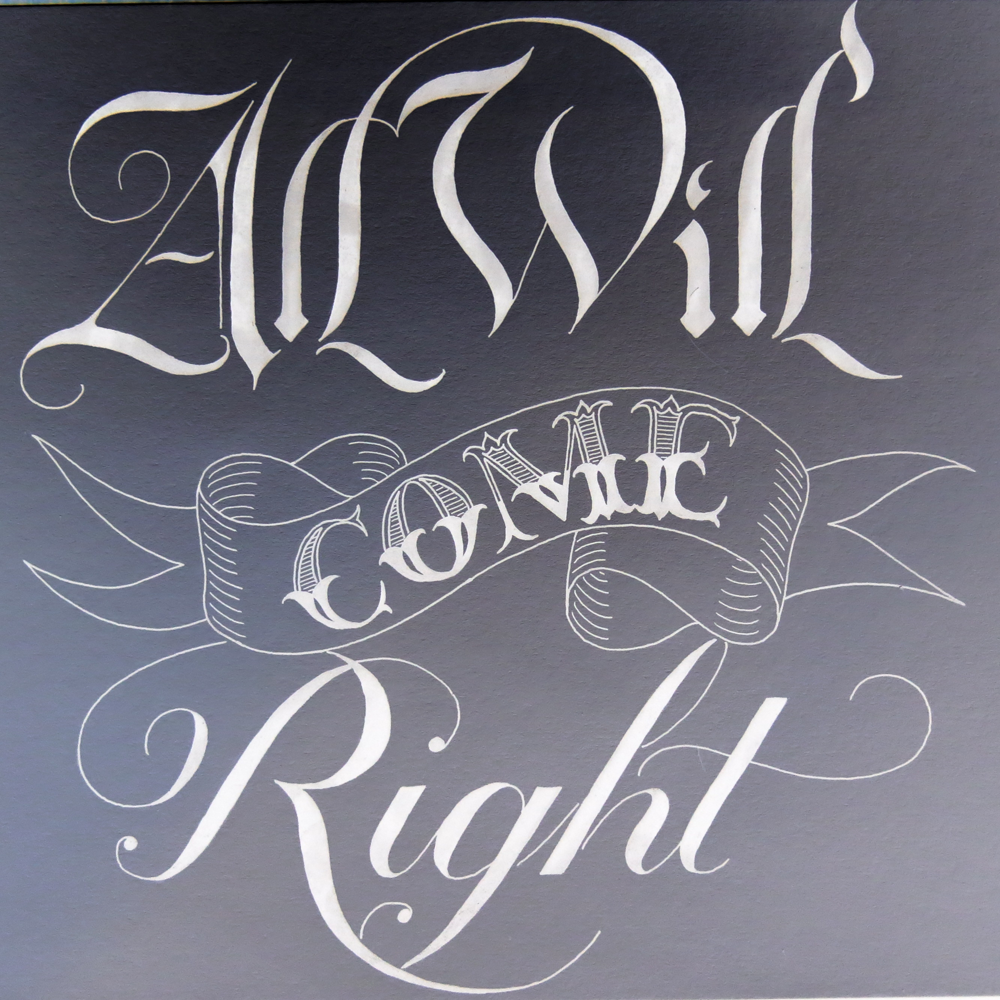
All Will Come Right

Last week, I did a piece that was part of a Churchill quote. This week, I have done the second half! The two pieces are designed to fit in a square shaped layout, and be displayed next to each other. Eventually (perhaps not next week, but at some point) they will be joined by a third piece which will fit beneath them, being twice as wide as it is high, so that the whole ensemble creates a larger square to complete the whole quotation.
All Will Come Right

I’ve inverted it here to give it a nice chalk board style look. It’s visually very similar to the piece last week (of course, that’s the point!) so to create a little contrast, I thought it would be nice to see it in white-on-black. It’s so simple to make it a negative, and it almost feels like cheating, because you end up with something that feels so different. Sometimes I see work done by others and I can’t tell if they’ve done it on black paper with chalk or or some other white medium or whether it’s a simple inversion, so it’s interesting to finally get round to doing so with a piece of my own.

Here are the two pieces in the same photo so you can compare:
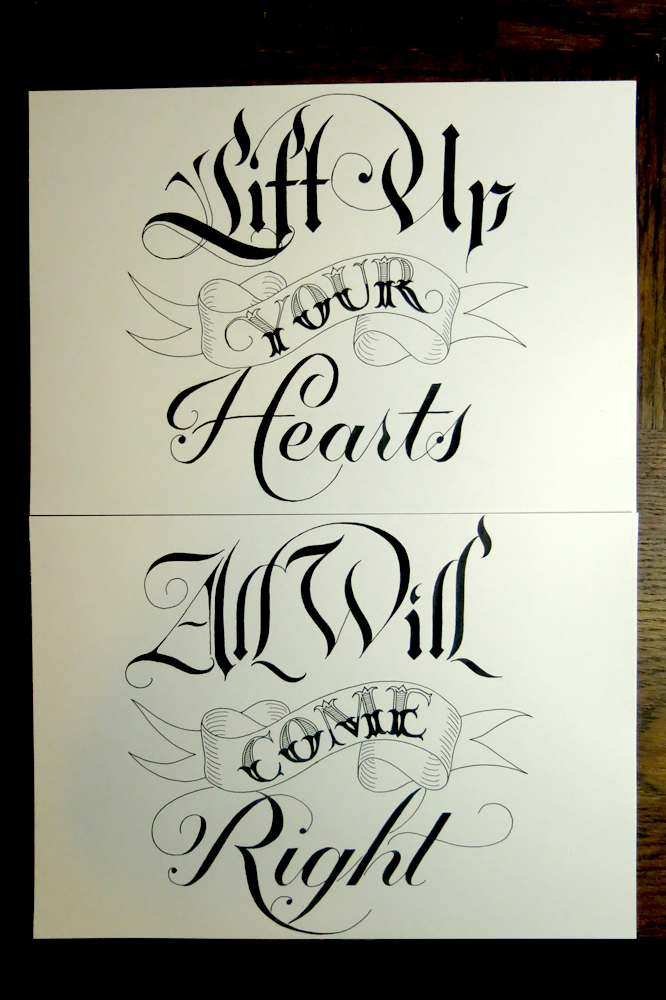
Lift Up Your Hearts, All Will Come Right

The goal was to make these pieces resemble each other as much as possible. The obvious choice is to have them structured the same, and to used the same styles. Of course, the similar sentence structure is not only useful as a tool of great rhetoric, but also helps with keeping the two pieces the same. It’s simple enough to see that the styles are the same, and that the banner in the middle is the same shape with the same Tuscan font, but there are also a few other structural similarities that I’ve worked into the pieces to keep them consistent. For instance, the underside of the first line swoops down, then up, in order to match the banner beneath it. Both pieces also have a semicircle in the centre at the top, and have a similar shape at the bottom with the leg of the H/R respectively.
Lift Up Your Hearts

Following on from last week, this week has seen a lot of broad nibbed calligraphy practice, which means burning through paper at an alarming rate! The good news is that I bought 20 nice A5 Rhodia notebooks a few weeks ago, half of them with a dot-grid pattern and the other half plain. The dot grid is great for sketching out ideas without having to worry about marking out boundaries and guidelines; unfortunately, the spacing between the dots don’t quite match the width of any of the broad nibbed pens I bought, so it doesn’t help too much with calligraphy practice.

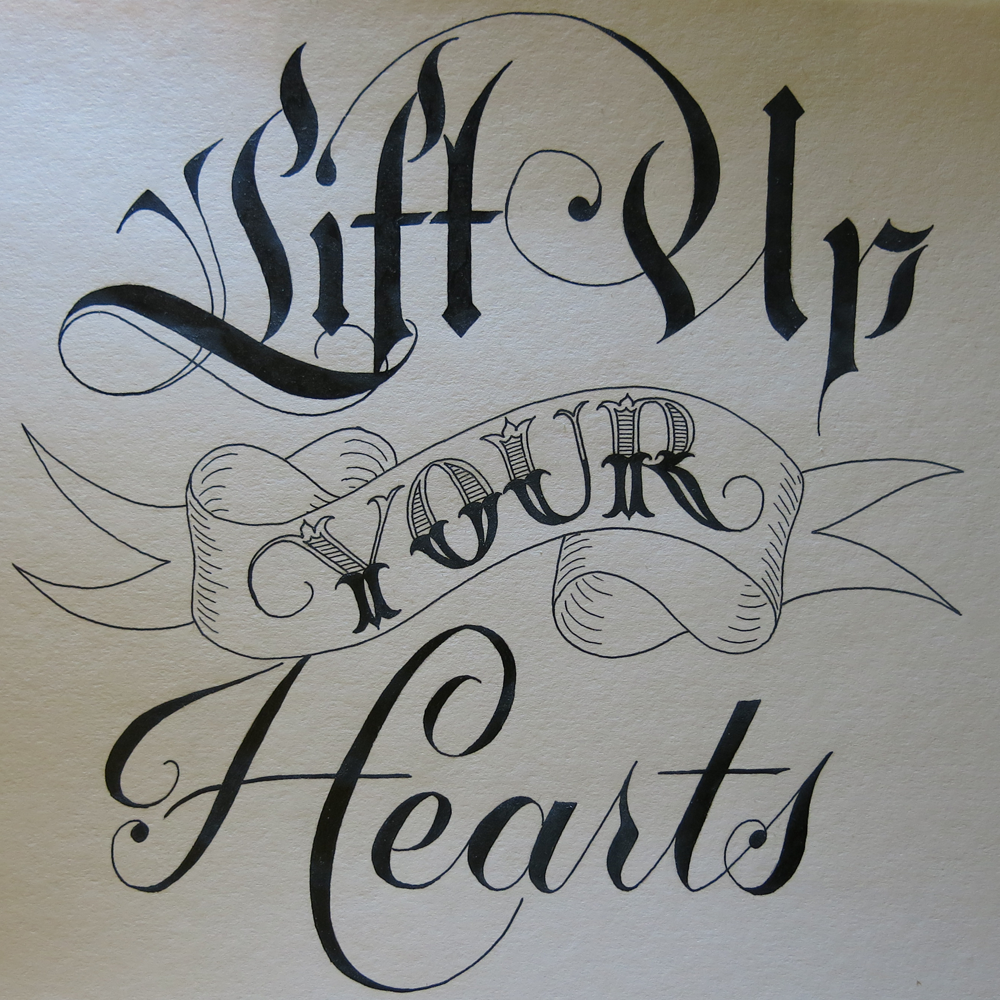
Lift Up Your Hearts

This piece is the first in a two (maybe three) part series that I’m going to do. The plan is to have them structurally as similar as possible. This one is half of a sentence spoken by Winston Churchill on June 12, 1941 in his speech to the Allied Delegates. I first heard it when it gained some popularity due to being auto tuned into a funny little song, but the meaning of the message stuck with me. The full phrase is “Lift up your hearts; all will come right.” It’s then followed with “Out of the depths of sorrow and of sacrifice will be born again the glory of mankind.” It’s stirring to think of the context in which those words were spoken. The Second World War had been going for two years, and would continue for another four. Knowing what we do now lends a feeling of gravity to the words, but I feel it’s a message that holds meaning in many contexts.

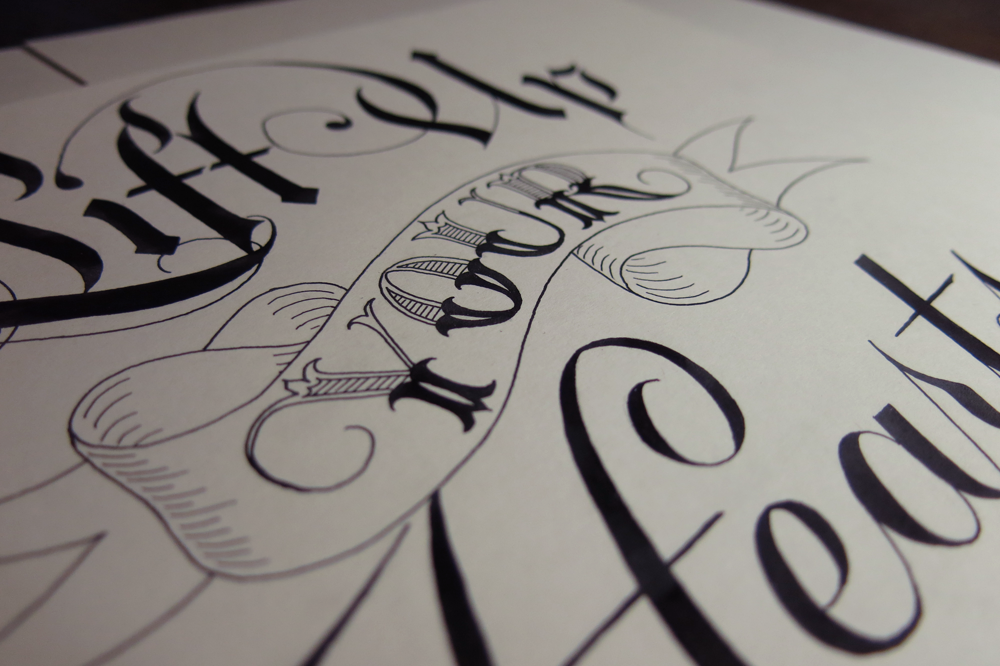
Here’s a shot that is a little closer and shows the banner and the Tuscan style lettering of the word “your”.

Lift Up Your Hearts Detail

The piece has quite bold and simple shapes on the top and bottom, so I kept the banner from being too detailed so that it doesn’t distract from other elements, whereas usually I like to include a bit more detail. The main reason I’m keeping it as simple as it is, however, is that for it to work side by side with the next piece in the series, being too detailed could make the composition look too busy. I may make a 3rd piece with the phrase “Out of the depths of sorrow and of sacrifice will be born again again the glory of mankind,” which would be a wider piece to fit beneath the first two above.

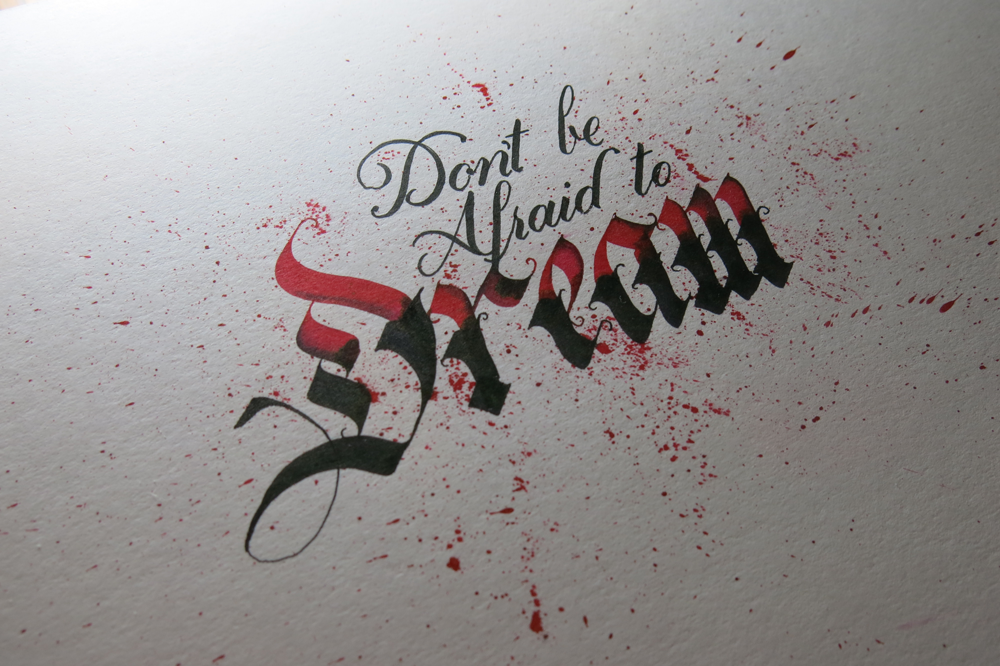
Don’t be Afraid to Dream

This week is another New-Pen-Week! Last time, I got some Rotring Rapidographs, which I use pretty much the same as the old fine liners I started out with. Not much changed in the style of work I produced, but for me, the process was changed a little. This time, however, I got some Pilot Parallels, which are a kind of fountain pen for broad nibbed calligraphy. I’ve been wanting to start practising some broad nibbed calligraphy for a while now, so that I can further my understanding of Gothic/Blackletter styles, and this week allowed me the chance to give it a go!

Don't be Afraid to Dream

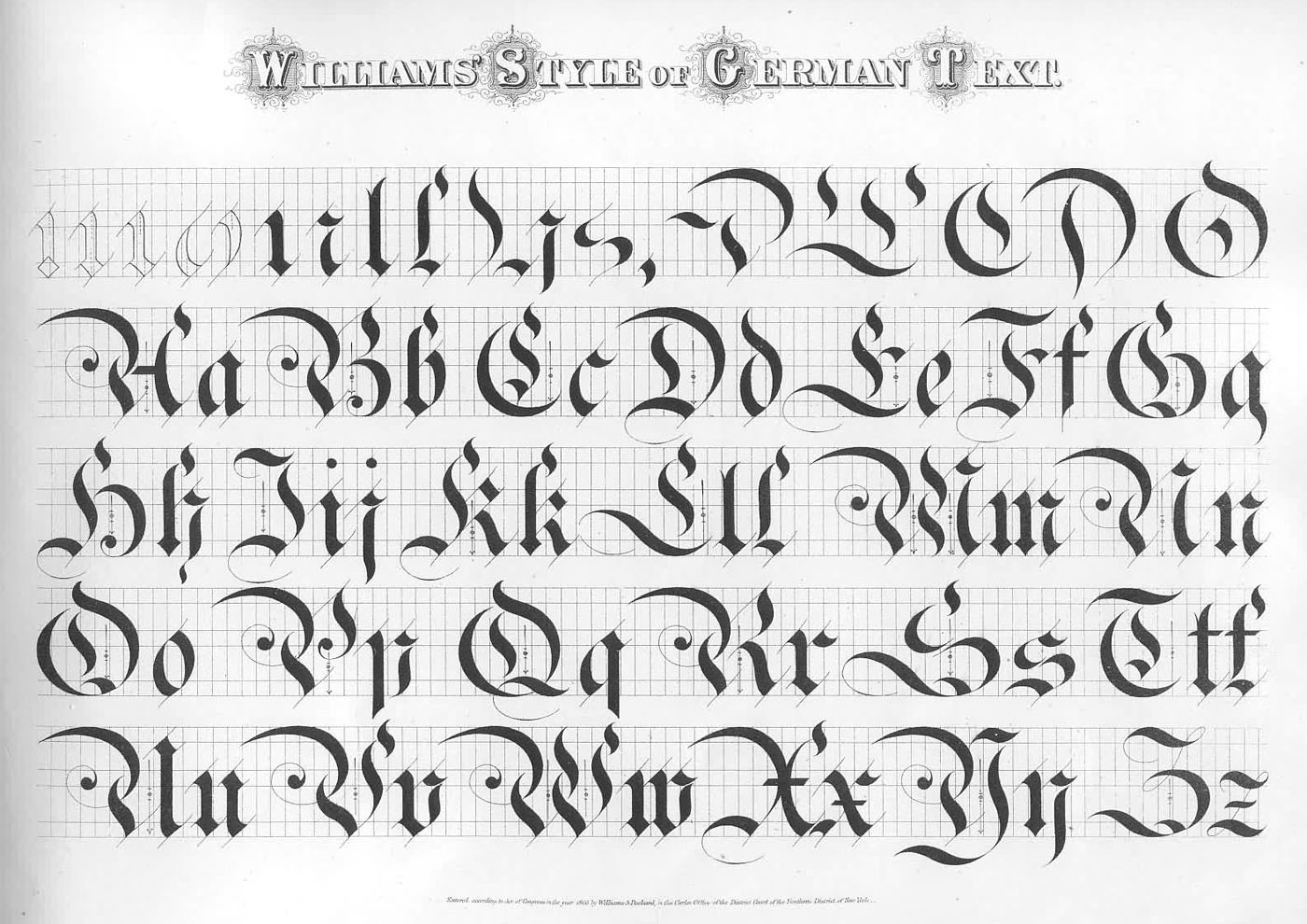
I found a wonderful image that displays a style of Blackletter that I haven’t seen reproduced quite the same anywhere else. The title of the image is “Williams Style of German Text”, which doesn’t seem to bring up much other than the original image, so I don’t have much more information than what you see there. I’m sure there is much to learn in exploring the style, and I’m going to spend the next few weeks trying to understand the intricacies of what makes the letters function in the way they do, but in the mean time, I took some inspiration from the style, as well as several other styles I’ve seen around the web, and came up with the piece above.

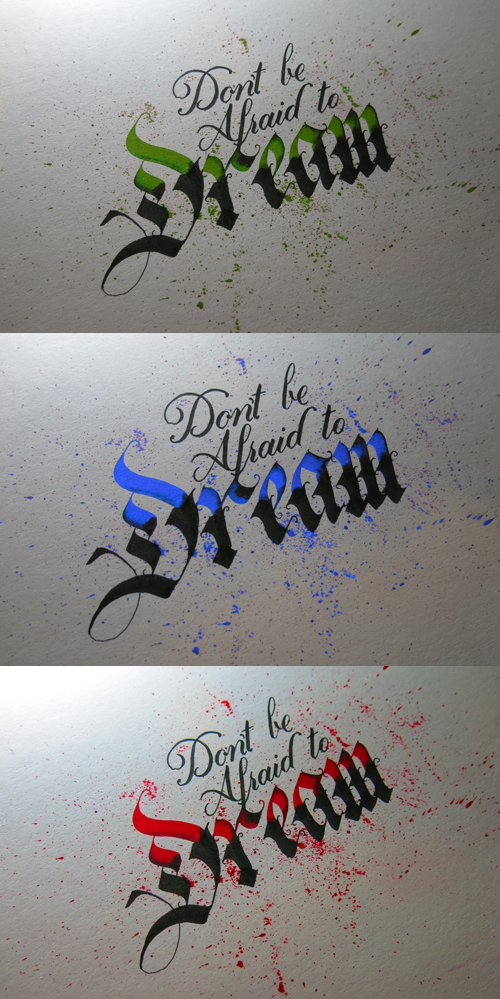
The pens came with two inks, which was unexpected, but it provided me with the opportunity to experiment with a bit of colour, which is something I’ve been purposefully avoiding in other works in an effort to focus on form. After all, restrictions are what give us guidance, and having too many directions to explore often leads to little progress. That being said, it’s sometimes refreshing to allow yourself a little deviation. These inks are black and red, though refills are available for all manner of colours, so I’m interested in getting some more in the future. In the mean time, I found neat feature on my camera that replaces individual colours in a photo for others, no photoshopping required. Here, I’ve replaced the red ink with a green, blue, and brighter red. Look how each colour creates a different feel for each piece. Colour matters!

Don't be Afraid to Dream Colours

The speckles that surround the letters were made by pulling on the tip of the nib, and letting it go, which flicks the ink on to the paper. Unfortunately, it also flicks it everywhere else, so I ended up with some red fingers, pens and surfaces. Before I did the speckles, I first drew out some guidelines for the word “Dream”, then wrote in the red parts. Once they were dry, I went over in black to complete the bottom part of each letter, then added in the Copperplate above with a brush pen. The speckles came in last because I didn’t want to get my hands so messy if I ended up making a mistake and discarding the paper!

A riddle

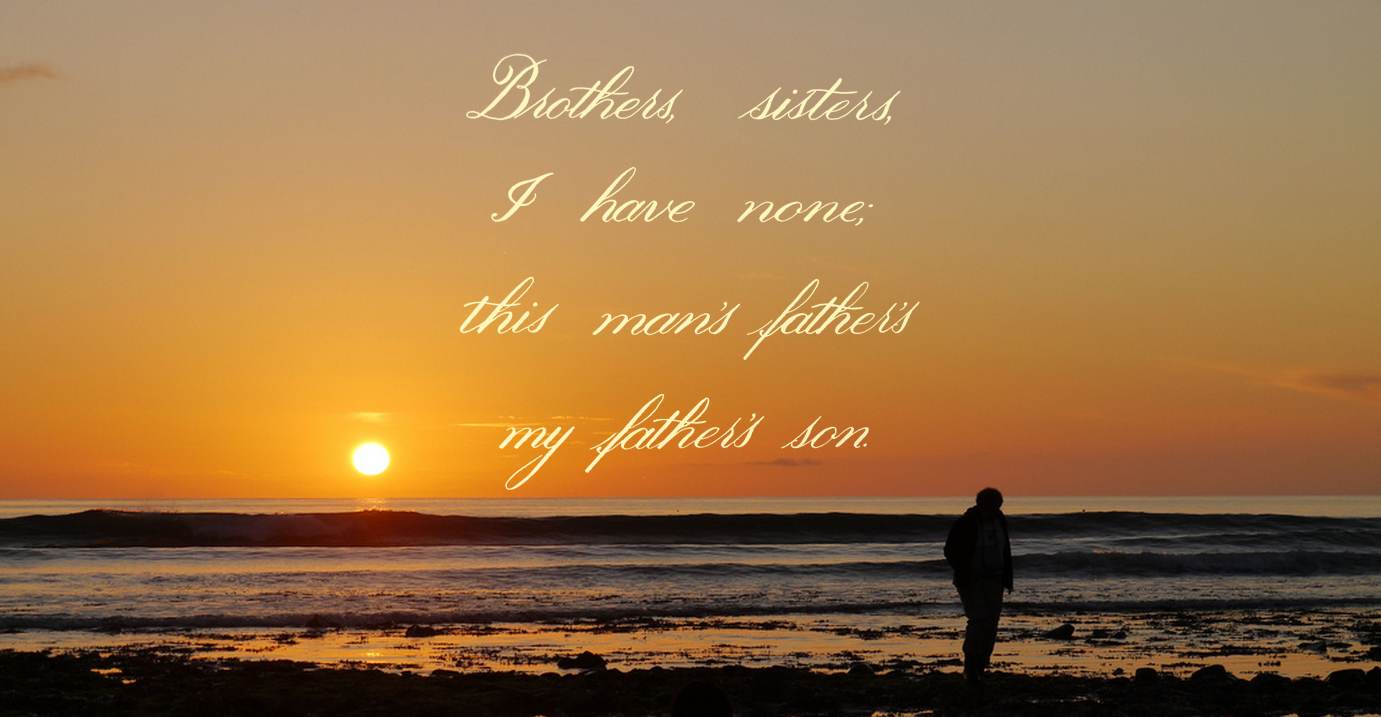
Today, I have a riddle for you. Take a look and see if you can figure it out.

Dad

The riddle, then, is who is “this man”?

Recently, I started out on a foray into the world of brush pens, and found myself going back to what had originally got me into lettering in the first place: copperplate. Copperplate is a kind of calligraphy that uses a thin flexible nib to create varying thickness in the letter strokes by applying pressure and spreading the tines, setting it apart from broad nib calligraphy like Gothic. Once I had bought a brush pen a few weeks ago, I found myself trying to recreate the elegance of copperplate without the hassle of having to use dip nibs and an ink well, and the messiness that goes along with it. However, I had the wrong pen, and it was terrible. Then, I bought a couple of Tombow Fudenosuke pens, and after an agonizing 2 week wait as they were shipped from Japan, they got here. I really can’t recommend them enough.

I’ve been practising with them for a week or two now, and I’m getting to grips with how they work. At the same time, I’ve been exploring using a bit of photo wizardry to transfer the lettering to sit on top of photographs, as you can see above. Regarding the riddle, seeing as it’s a family matter, I chose a photo of my father, taken by my mother. That’s not a hint though! You’ll have to figure out the answer on your own. If you’re really stuck, a quick google will tell you the answer, but it’s a fun piece of mental gymnastics to go through to figure out the answer, much like phrases such as “I couldn’t fail to disagree with you less” and those sentences with the same word over and over again that still make grammatical sense.

Take a look at the unadulterated version of the lettering below to get more of an insight into what the original looks like:

Brothers, Sisters Riddle